
Science & Society
From science policy to societal impact
Molecular life science research makes major contributions to societal goals such as understanding and controlling human diseases, developing new medicines, materials and foods, as well controlling diseases of plants and animals. The public, policy makers and the media take interest in many issues related to the aims, outcomes and implications of such research, which often has an ethical dimension. Among recent publicly debated issues are vaccination, stem cell research, personalized medicine and genetically modified organisms.
The FEBS Science and Society Committee works at the interface between scientists, policy makers and the wider public with the following main aims:
- To contribute to shaping of effective science policy at the European level, for example by consulting with and acting as a unified voice for FEBS Constituent Societies and their members, or through collaborating with other European organizations with shared goals. Two main areas of interest are funding and regulation.
- To raise awareness among molecular life scientists of research developments and associated ethical/legal considerations in areas with high societal interest, for example through organizing a Science and Society session at the FEBS Congress on such a topic.
- To increase public understanding of science, for example by providing grants to FEBS Constituent Societies for public outreach activities in their countries.
UPCOMING ACTIVITIES
Call for proposals: FEBS Supported Science and Society Events
FEBS Constituent Societies can apply for funding to organize Science and Society events taking place between January and June 2027, aimed at increasing public understanding of the molecular life sciences and strengthening engagement between science and society.
Funding of up to €2,000 for in-person events and €750 for online activities is available. A wide range of formats is encouraged, including public lectures, workshops, science cafés, activities for schools, science communication initiatives and innovative online activities.
Applications are open from 15 September to 15 December 2026.
To apply, please complete the application form and submit it by 15 December 2026.
Recent Activities
FEBS Supported Science and Society Events: 2026 call closed
The latest call for FEBS Supported Science and Society Events, covering activities taking place between September and December 2026, is now closed.
FEBS Constituent Societies were invited to apply for funding to support public engagement activities aimed at increasing understanding of the molecular life sciences and strengthening connections between science and society.
Selected events will be announced by the end of October 2026.
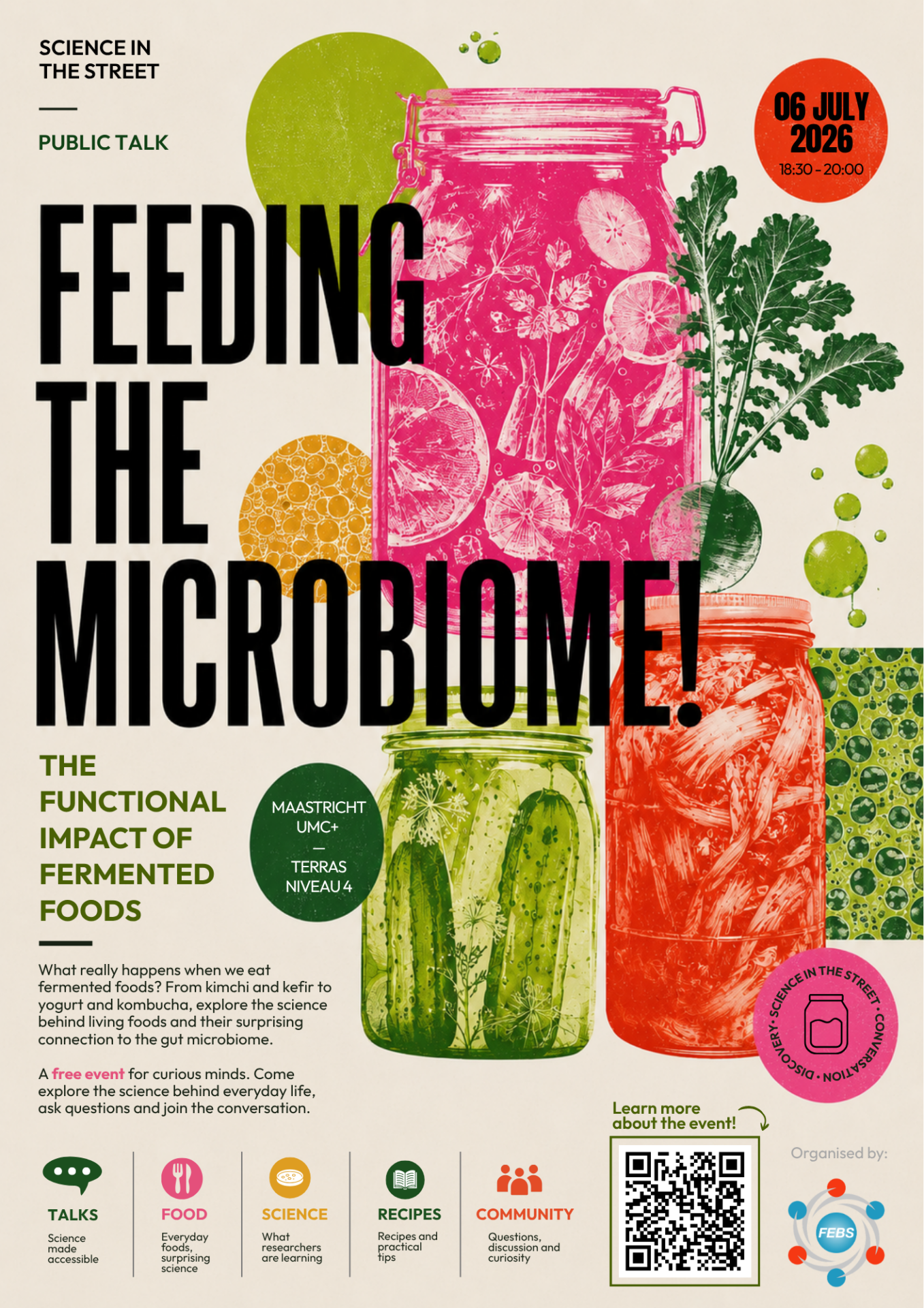 This public engagement event, held on 6 July 2026 during the 50th FEBS Congress in Maastricht, explored how fermented foods such as yogurt, kefir, kimchi and kombucha interact with the gut microbiome and may influence human health. Titled Feeding the Microbiome, the session examined how fermented foods can act as ecological modulators within the gut ecosystem, with discussions on microbial diversity, metabolism and immune function, followed by informal networking.
Science in the Street Event at the 49th FEBS Congress, Istanbul: Groove on the Brain: How Jazz Shapes the Mind
Science in the Street Event at the 48th FEBS Congress, Milano: The importance of doing the right thing at the right time. How the circadian rhythms improve the quality of life
This FEBS Congress Special Session open to the public, held at Aula Magna at the University of Milano on 1 July 2024, included talks from Kramer Achim (Berlin) on ‘The rhythms of life: How our internal clock regulates health and well-being’ and Dibner Charna (Geneva) on ‘The importance of being rhythmic: keeping your body metabolism in synchrony’.
FEBS support for ‘Science and Society’ Constituent Society events/activities
2023
Grants of €1500 from FEBS were awarded by the FEBS Science and Society Committee to:
- the Croatian Society for Biochemistry and Molecular Biology (HDBMB) for the popular science event ‘Contribution of bioscience to the green transition’ (24 May 2023; Zagreb, Croatia). Read more about the event on this FEBS Network post.
- the Portuguese Biochemical Society (SPB) for an open symposium and exhibition on ‘Exploring RNA solutions to infectious and non-communicable diseases’ (27 November – 13 December 2023; Porto, Portugal). Read more about the event on this FEBS Network post.
2022: plastics theme
Grants of €1500 from FEBS were awarded by the FEBS Science and Society Committee to:
- the Italian Society of Biochemistry and Molecular Biology (SIB) for the public engagement event ‘I’m in plastic: it’s not fantastic’ (15 November 2022; University of Insubria, Varese, Italy). Read more about the event on this FEBS Network post.
- the Spanish Society for Biochemistry and Molecular Biology (SEBBM) for a video project. Watch the video on the FEBS Network.
Science and Society session topics at recent FEBS Congresses
- 2023 (Tours) Nutrition and exercise as important factors for the proper function of the biochemical metabolism. Find out more about the session on this FEBS Network post.
- 2022 (Lisbon) RNA solutions to genetic and infectious diseases.
- 2021 (Ljubljana – Virtual) Plastics: revolution, pollution and substitution. Find out more about the session on this FEBS Network post.
- 2019 (Krakow) Personalised medicine: a future vision. Find out more about the session on this FEBS Network post.
- 2018 (Prague) Healthy microbiome, healthy host? Find out more about the session on this FEBS Network post.
- 2017 (Jerusalem) The role of CRISPR in personalized medicine: legal and ethical problems.
Other work and resources
Science policy
The Initiative for Science in Europe (ISE) is an independent association that unites European learned societies and scientific research organizations spanning all disciplines and research sectors. ISE actively involves researchers in shaping and implementing European science policies and advocates for robust, independent scientific advice in the development of broader European policies. The organization has been pivotal in championing disruptive, excellence-based funding programs for scientific research and played a central role in establishing the European Research Council (ERC).
FEBS is a member of ISE and through that involvement FEBS contributes to shaping scientific policies and influencing the funding landscape for research and innovation via the EU’s key programs. Last year, informative ISE meetings and the ISE General Assembly were held in Brussels, with Dr. Melita Vidaković participating as a FEBS representative. Through ISE and the efforts of its Executive Committee, FEBS actively advocates for critical initiatives such as enhancing career development opportunities for young researchers, ensuring secure social and pension schemes, expanding opportunities for widening countries, and advocating for improved funding mechanisms in the upcoming Framework Programme (FP10).
Under the umbrella of the BioMed Alliance, FEBS participated in efforts with other organizations to obtain from the EU the best research budget for the Framework Program FP9. After the completion of discussions on FP9, and the allocation of the budget to the three ‘pillars’ and ‘horizontal actions’, efforts were focused on informing Constituent Societies about possibilities being developed in Pillars I and II for applications to competitive programs, and, with organizations such a the BioMed Alliance, inputting into criteria for programs and reviewer selection.
The past role of FEBS, together with other research organizations in Europe, in working towards the creation of the European Research Council (ERC) for investigator-driven funding within Europe is described in Celis, J.E. and Gago, J.M. (2014) Shaping science policy in Europe. Mol. Oncol. 8, 447–457
Research Integrity: A Code of Conduct
Ethical conduct is demanded in all activities supported by FEBS. Given increased concerns among scientists and the public about good research practice, and following discussion of codes of conduct by the FEBS Science and Society Committee, FEBS decided to subscribe to the European Code of Conduct for Research Integrity, prepared by the European Science Foundation/All European Academies. FEBS is grateful to the European Science Foundation for permission to refer to it. The Code calls for researchers, public and private research organizations, universities and funding organizations to observe and promote the principles of integrity in scientific and scholarly research, including reliability in performing research, honesty in communication, objectivity, impartiality and independence, openness and accessibility, duty of care, fairness in providing references and giving credit, and responsibility for the scientists and researchers of the future.
For members of the Science and Society Committee, click here.